
Critical Inquiry
CIM402 introduces postgraduate students to critical inquiry as an active component of creative practice. The unit focuses on how cultural theory, philosophy, and critical frameworks can be used as tools for thinking, making, analysing, and reflecting on creative work, rather than as abstract bodies of knowledge to be memorised.
Journal 1 - Aesthetic Identity
The Correct Proportions
First, the line.
Then another
placed carefully beside it.
A distance agreed upon.
Stone remembers the hand
long after the hand
has disappeared.
Behind glass,
something waits.
A number.
A date.
A place
written in another language.
The name is missing.
Still,
we know what to call it.
Beautiful.
Outside,
a root lifts the pavement
by a few quiet millimetres.
No symmetry.
No permission.
A bird carries something
from one side of the garden
to the other.
The boundary remains
on the map.
There was once a word here.
There was once a hand
that knew the weight of this.
There was once a way
of looking
that required no frame.
Now
white wall,
soft light,
measured distance.
Do not touch.
Somewhere beneath the label
the object keeps
its other name.
Somewhere beneath the road
the earth keeps
its shape.
And somewhere
a ruler lies
in the grass,
slowly disappearing.
Exegetical Statement - The Correct Proportions
The Correct Proportions brings universal principles of beauty into tension with a postcolonial subject position. The work asks whether beauty can be universally experienced while the systems used to define, classify and legitimise it remain culturally situated. Rather than simply rejecting universality as a Western construction, I became interested in a more difficult question: can institutions recognise beauty across cultures without translating difference into their own systems of value?
Tatarkiewicz’s (1963) examination of objectivity and subjectivity in aesthetics provides the starting point for this inquiry. The historical pursuit of proportion, harmony and order suggests a desire to locate beauty beyond individual preference. This informed the poem’s opening: “First, the line. / Then another / placed carefully beside it.” The line represents measurement and the desire to make aesthetic experience knowable. However, it also becomes a boundary: between what is recognised and excluded, named and unnamed, valued and overlooked.
Bourdieu’s (1986) concept of cultural capital complicates the possibility of neutral aesthetic judgement by demonstrating how cultural value is shaped through social structures and acquired knowledge. This raises the possibility that what appears universally beautiful may partly reflect the successful legitimisation of particular aesthetic traditions. Adorno and Horkheimer’s (2002) critique of cultural standardisation extends this concern. Repetition can make constructed values appear natural, allowing dominant aesthetic conventions to become difficult to recognise as conventions at all.
The museum imagery translates these theoretical questions into an institutional space. An object sits behind glass accompanied by “a number / a date / a place,” while “the name is missing.” Benjamin’s (2008) consideration of the changing status of artworks through technological reproducibility informed my interest in what occurs when objects move beyond their original contexts. Barthes (1977) similarly destabilises singular authority over meaning. However, within a postcolonial context, removing singular authorship presents a further contradiction: declaring meaning open cannot erase unequal histories determining who had the power to collect, classify, preserve and interpret cultural material.
This contradiction is central to my understanding of institutional decolonisation. Threadgold’s (2003) engagement with cultural studies and the popular encourages attention to the processes through which cultural meanings and values are produced, while Probyn’s (1996) exploration of belonging informed the poem’s recurring concern with objects, knowledge and place. Decolonisation therefore cannot be achieved simply by expanding the range of cultures represented within museums, galleries and universities. If institutions diversify what is displayed while retaining exclusive authority over how knowledge is named, organised and valued, the underlying structure remains largely intact.
The final image of a ruler “slowly disappearing” into grass does not advocate abandoning existing knowledge. Instead, it imagines the ruler losing its status as the only legitimate measure. The poem ultimately proposes decolonisation as an expansion of epistemic authority: allowing different communities, knowledge systems and forms of custodianship to shape how culture is interpreted and valued. Universal beauty is therefore left deliberately unresolved. The question becomes not whether humans can share experiences of beauty, but whether our institutions can encounter difference without first requiring it to fit within the measurements they already understand.
References
Adorno, T. W., & Horkheimer, M. (2002). The culture industry: Enlightenment as mass deception. In G. S. Noerr (Ed.), Dialectic of enlightenment: Philosophical fragments (E. Jephcott, Trans., pp. 94–136). Stanford University Press. (Original work published 1944)
Barthes, R. (1977). The death of the author. In S. Heath (Trans.), Image, music, text (pp. 142–148). Hill and Wang. (Original work published 1967)
Benjamin, W. (2008). The work of art in the age of its technological reproducibility. In M. W. Jennings, B. Doherty, & T. Y. Levin (Eds.), The work of art in the age of its technological reproducibility, and other writings on media (pp. 19–55). Harvard University Press. (Original work published 1936)
Bourdieu, P. (1986). The forms of capital. In J. G. Richardson (Ed.), Handbook of theory and research for the sociology of education (pp. 241–258). Greenwood Press.
Probyn, E. (1996). Outside belongings. Routledge.
Tatarkiewicz, W. (1963). Objectivity and subjectivity in the history of aesthetics. Philosophy and Phenomenological Research, 24(2), 157–173. https://doi.org/10.2307/2104458
Threadgold, T. (2003). Cultural studies and the popular. Continuum: Journal of Media & Cultural Studies, 17(1), 1–14.
Journal 2 - Poststructuralist Creative Action
What Remains of a Name
I left a word
somewhere between
the mouth and the meaning.
It was mine
until it was spoken.
Then it belonged to the room,
to the walls,
to the silence that followed.
Someone called it truth.
Someone else
remembered it differently.
A name appeared
where a body should have been.
Beneath it,
another name.
Beneath that,
the impression of something
once believed to be certain.
I tried to return
to the beginning,
but the beginning
had already been written
by someone who was not there.
Perhaps I was the voice.
Perhaps I was only
the space
in which it happened.
Here is the sentence
I meant to leave behind:
I am
But the rest
belongs to
whoever is reading.
Exegetical Statement - What Remains of a Name
What Remains of a Name is an experimental poststructuralist poem investigating the instability of meaning, the construction of authorship and the relationship between language and identity. Rather than treating poetry as the expression of a singular creative consciousness, I approached writing as a process in which meaning emerges through language, cultural associations and interpretation. The central inquiry became: if the author cannot ultimately control meaning, what does it mean to create something intentionally?
Barthes' (1977) The Death of the Author provided the conceptual foundation. His argument challenges the assumption that a text possesses a definitive meaning originating from its creator. Instead, meaning emerges through the interaction of multiple cultural and linguistic influences, with the reader occupying a central interpretive position. I explored this through the opening statement, "I left a word / somewhere between / the mouth and the meaning." The separation between language and intention introduces the possibility that words acquire significance beyond their speaker's control.
Foucault's (1984) What Is an Author? complicates this position by examining authorship as a function through which discourse is classified, attributed and regulated. This prompted me to question whether removing the author's authority genuinely liberates meaning, or simply obscures the structures through which certain interpretations become legitimate. The recurring imagery of names and absent bodies reflects this tension. A name appears to establish identity, yet the poem repeatedly destabilises the relationship between the name, the speaker and the person supposedly represented.
The creative process also challenged my attachment to coherence. As a practitioner, I often approach composition through deliberate structural and aesthetic decisions. Poststructuralist experimentation required me to reconsider whether clarity and authorial intention should remain the primary measures of creative success. Nowotny's (2016) discussion of uncertainty as productive within knowledge creation informed my willingness to leave contradictions unresolved. Rather than constructing a definitive conclusion, I allowed uncertainty to become a compositional principle.
Adorno and Horkheimer's (2002) critique of cultural standardisation introduces a further complication. If cultural production frequently privileges recognisable structures and predictable meanings, disrupting those conventions might create space for alternative interpretations. However, experimentation does not automatically escape established aesthetic systems. Even fragmentation and ambiguity can become recognisable artistic conventions. This raises an uncomfortable question: does deliberately resisting structure create genuine disruption, or simply reproduce another established language of artistic rebellion?
The final unfinished statement, "I am", embodies this contradiction. Although I intentionally constructed the absence that invites interpretation, I cannot determine how the reader completes it. My creative authority is therefore neither entirely present nor entirely absent.
Ultimately, this experiment shifted my understanding of authorship from ownership toward participation. The poem does not establish that meaning is limitless or that authorial intention is irrelevant. Instead, it demonstrates how meaning remains contingent upon relationships between language, context and interpretation. Its unresolved ending is not an absence of meaning, but an invitation to recognise that meaning may always be otherwise.
References
Adorno, T. W., & Horkheimer, M. (2002). The culture industry: Enlightenment as mass deception. In G. S. Noerr (Ed.), Dialectic of enlightenment: Philosophical fragments (E. Jephcott, Trans., pp. 94–136). Stanford University Press. (Original work published 1944)
Barthes, R. (1977). The death of the author. In S. Heath (Trans.), Image, music, text (pp. 142–148). Hill and Wang. (Original work published 1967)
Foucault, M. (1984). What is an author? In P. Rabinow (Ed.), The Foucault reader (pp. 101–120). Pantheon Books. (Original work published 1969)
Nowotny, H. (2016). The cunning of uncertainty. Polity Press.
Journal 3 - Semiotics in Practice
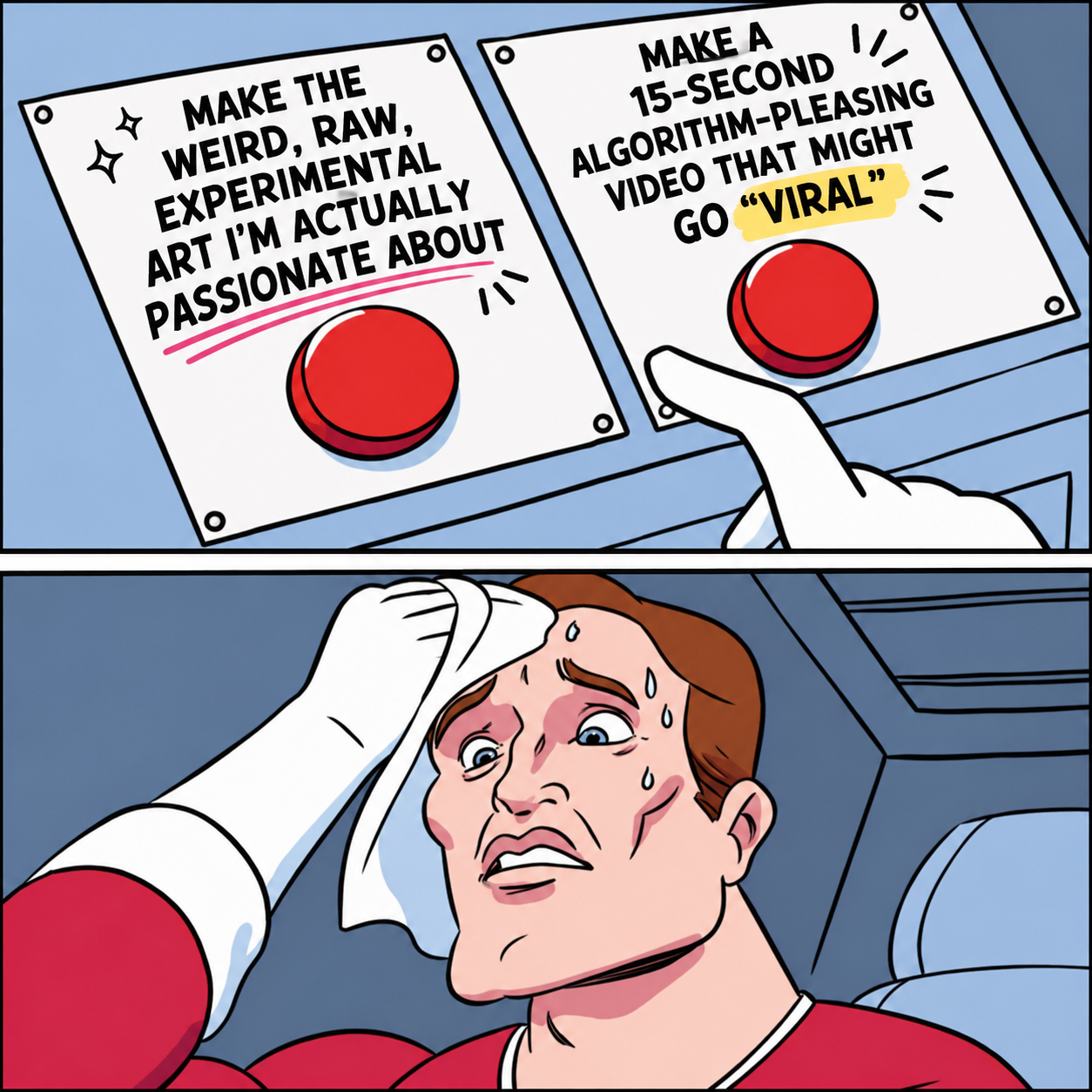
Exegetical Statement - Creativity in the Age of the Algorithm
My meme explores the tension between artistic authenticity and the increasing pressure to create content that performs well on social media. Using the familiar Two Buttons meme format, I examine how digital platforms influence creative decisions and challenge traditional understandings of artistic expression. Through humour, exaggeration and recognisable cultural symbols, the meme critiques the expectation that contemporary creatives must prioritise visibility and engagement over personal artistic fulfilment.
The meme presents two conflicting choices: “Make the weird, raw, experimental art I'm actually passionate about” and “Make a 15-second algorithm-pleasing video that might go viral.” These statements represent competing values within contemporary creative culture. The first symbolises artistic freedom, experimentation and personal expression, while the second represents commercialisation, digital visibility and the pursuit of online validation. The sweating character communicates anxiety and indecision, exaggerating the emotional pressure associated with navigating these expectations.
From a semiotic perspective, the meme relies on culturally recognisable signs to communicate its message. The red buttons signify a difficult decision, while the character's exaggerated facial expression conveys psychological discomfort. The humour emerges from the contrast between the apparent simplicity of choosing between two buttons and the complicated reality of maintaining artistic integrity within an algorithm-driven environment. The audience must understand both the conventions of internet memes and the pressures of social media to fully interpret the joke.
Adorno and Horkheimer's (2002) concept of the culture industry provides a theoretical framework for understanding this tension. They argue that cultural production becomes increasingly standardised under capitalism, prioritising commercial interests over artistic individuality. This perspective remains relevant to digital platforms, where creators may feel encouraged to reproduce popular formats rather than pursue experimental ideas. Ironically, my meme participates in this process by using an established, recognisable format to communicate its criticism.
Benjamin's (2008) discussion of technological reproducibility further informs my creative choices. Memes are inherently reproducible cultural objects, gaining significance through adaptation, repetition and circulation. By repurposing an existing visual template, I demonstrate how meaning can be reconstructed through new text and contemporary cultural references. The meme's familiarity also increases its accessibility, allowing audiences to recognise its structure before interpreting its specific message.
Barthes (1977) challenges the assumption that authors determine the definitive meaning of their work. Although I intended the meme to critique algorithmic pressures on creativity, audiences may interpret it differently depending on their experiences. Content creators may recognise a genuine professional dilemma, while other viewers may simply appreciate the humour or perceive the conflict as exaggerated.
Ultimately, the meme demonstrates how familiar digital imagery can communicate complex cultural tensions through accessible humour. By combining visual symbolism, irony and cultural references, I aim to encourage audiences to question how algorithmic expectations influence creative expression, while acknowledging that the meme itself exists within the systems it critiques.
References
Adorno, T. W., & Horkheimer, M. (2002). The culture industry: Enlightenment as mass deception. In G. S. Noerr (Ed.), Dialectic of enlightenment: Philosophical fragments (E. Jephcott, Trans., pp. 94–136). Stanford University Press. (Original work published 1944)
Barthes, R. (1977). The death of the author. In S. Heath (Trans.), Image, music, text (pp. 142–148). Hill and Wang. (Original work published 1967)
Benjamin, W. (2008). The work of art in the age of its technological reproducibility. In M. W. Jennings, B. Doherty, & T. Y. Levin (Eds.), The work of art in the age of its technological reproducibility, and other writings on media (pp. 19–55). Harvard University Press. (Original work published 1936)
Journal 4 - Affect and Creative Practice
Exegetical Statement - Creating Fear Through Sound
For this creative investigation, I produced a 20-second experimental soundscape designed to evoke fear, specifically apprehension and unease, as identified through Plutchik's Wheel of Emotions. Rather than relying on a conventional musical structure or narrative, I explored how sound design can influence an audience's emotional and physiological responses. Through low-frequency textures, rhythmic repetition, unsettling sonic layers and abrupt dynamic changes, I aimed to create a sense of escalating tension and uncertainty.
The composition begins with a low, ominous drone accompanied by a repetitive, heartbeat-like pulse. This rhythmic element establishes a sense of anticipation while referencing the body's physiological response to fear. As the soundscape progresses, watery, bubbling textures emerge, introducing an unfamiliar and increasingly unsettling atmosphere. These sounds gradually overlap with the underlying pulse, creating a complex sonic environment in which the listener struggles to anticipate what might happen next. Towards the conclusion, the introduction of harsh, distorted sounds and sudden percussive impacts creates a dramatic increase in intensity before the composition fades into near silence.
My creative decisions were informed by affect theory, particularly the distinction between affect and emotion. Affect can be understood as the intensity of bodily responses that may occur before an experience is consciously recognised or categorised as a particular emotion. Emotion, conversely, refers to the identifiable feeling that emerges through the interpretation of these experiences. Sedgwick (2003) explores the relationship between affect, bodily experience and emotional interpretation, providing a framework for understanding how creative works can influence audiences beyond conscious meaning-making. Within my soundscape, the repetitive pulse and increasing sonic intensity are intended to generate physical tension and heightened alertness before the listener consciously identifies fear.
Grosz (1994) further informs this investigation through her examination of embodiment and the relationship between the body and its environment. Her perspective challenges the separation of physical experience from psychological interpretation. Applied to sound design, this suggests that listening is not simply an intellectual process but an embodied experience. The low-frequency elements and sudden dynamic shifts in my composition were deliberately selected to encourage a visceral response, potentially influencing the listener's sense of comfort, anticipation and spatial awareness.
Additionally, Deleuze and Guattari (1987) provide a useful theoretical perspective through their exploration of intensities and the relationships between different elements of experience. Rather than communicating fear through an explicit narrative, I constructed an evolving arrangement of sonic textures, allowing tension to emerge through their interaction. The gradual accumulation of sounds creates anticipation, while the abrupt conclusion disrupts the listener's expectations.
Ultimately, this investigation demonstrates how sound can function as an affective medium, communicating through sensory intensity rather than explicit representation. By manipulating rhythm, frequency, texture, dynamics and silence, I sought to create an embodied experience of apprehension. Although individual responses will vary, the composition illustrates how deliberate creative decisions can encourage emotional engagement through sound.
References
Deleuze, G., & Guattari, F. (1987). A thousand plateaus: Capitalism and schizophrenia (B. Massumi, Trans.). University of Minnesota Press. (Original work published 1980)
Grosz, E. (1994). Volatile bodies: Toward a corporeal feminism. Indiana University Press.
Sedgwick, E. K. (2003). Touching feeling: Affect, pedagogy, performativity. Duke University Press.